Before 1s and 0s
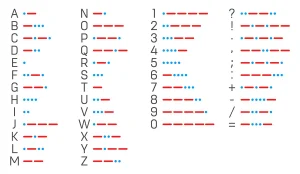
Before everything became digital, there was Morse code. It was a system of dots and dashes that completely changed how people communicated. It might not seem digital in the way we think of it today, but it was an early way of encoding information. It turned letters and numbers into structured patterns that could be sent and received. This was basically an early version of what we do now with computers, just in a much simpler form.
Was Morse Code Actually Digital
Morse code was created in the 1830s by Samuel Morse and Alfred Vail, and it worked by using short and long signals to represent letters. This made it possible to send messages instantly over telegraph wires, which was a huge deal back then. If you think about it in terms of digital versus not digital, it is kind of in the middle. It does not use ones and zeros like modern digital systems, but it does break information down into a structured system that can be transmitted and decoded. That is basically the same idea.
How It Changed Communication
The big advantage of Morse code was speed and accuracy. Before it, people had to rely on handwritten letters, which took days or even weeks to arrive. Suddenly, messages could be sent almost instantly across long distances. This is the same advantage we get today with digital communication. Compared to something like a handwritten letter, a text or email is way faster and more reliable.
But just like modern digital systems, Morse code had tradeoffs. It required skilled operators to send and receive messages, and it was limited to a pretty basic character set. Today, we see the same kind of thing with digital media. We can compress music and video to make it easier to store and send, but we lose some of the detail in the process.
What We Gain and What We Lose
Morse code was way more efficient than speaking or writing, but it also removed a lot of the depth and nuance. When we talk in person, we have tone, facial expressions, and other things that add meaning. Morse code stripped all of that away and focused just on the message itself. This is kind of like how digital photos capture a moment but do not fully replicate the real thing.
We see this tradeoff in everything digital today. Social media lets us connect instantly, but we miss out on the in person experience. Streaming music is super convenient, but it does not have the same richness as live sound. The more we digitize things, the more we gain in efficiency, but sometimes we lose a little of what makes them feel real.
Why Morse Code Still Matters
Even though Morse code is not something we use every day anymore, it was one of the first examples of structured digital communication. It proved that language could be turned into a system that machines and people could both understand, and that concept is basically what powers everything digital today.
Looking at Morse code makes it clear that digitization is not just about computers. It is about taking something natural and finding a way to structure it so it can be stored, sent, and processed more easily. It is crazy to think that something developed in the 1800s was already laying the groundwork for how we communicate now, but that is exactly what happened.
(OpenAI was used to help write this)